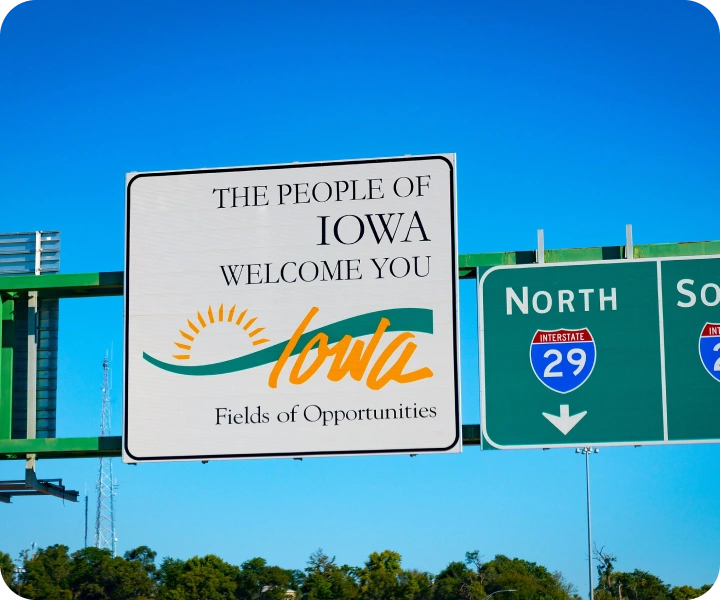
Iowa major corridors — I-80, I-35, I-29, and the farm-to-market grid
If you’ve crossed Iowa even once, you might remember it as long straight roads and a lot of sky. Freight logistics during winter storms or the autumn harvest shift your perception even more here. Soon enough, every highway is unique, and they each behave in their own distinct way at every time of the day and year.
Iowa is a national leader in real-time logistics technology. The state’s Truck Parking Information Management System (TPIMS) provides live availability data for 43 locations, including both public rest areas and private truck stops. This system helps drivers navigate the state's 18 interstate and 38 primary highway monitored sites to ensure safer route planning.
Iowa major corridors
I-80
The most crucial east-west artery, carrying cross-country freight from Council Bluffs to Davenport. Drivers can 'read the highway' as reefer trains form ahead of cold fronts and couriers race to beat imminent storms. It is home to the world's largest truck stop at Walcott.
I-35
The central north-south spine connecting Minnesota to Missouri. North of Ames, open land creates a constant side-push from the wind. Southbound lanes carry the energy of Kansas City freight, shifting with the construction season's supply chain needs.
I-29
A river-hugging route that behaves differently whenever the Missouri River rises. While it often requires workarounds for overnight closures or detours, it is considered one of the smoothest rides in the state when calm.
Farm-to-Market Grid
A network of smaller highways and rural routes connecting grain sites, ethanol plants, and feed mills. During harvest, drivers often crawl behind combines; in Iowa, patience is standard as these machines belong to the very people buying the hauled fuel.
Iowa local rules & compliance
Iowa's legal landscape for 2025 emphasizes safety and proper staging. While there is no statewide idling ban, university towns like Ames and Iowa City are noise-sensitive, making industrial outskirts the best choice for parking to avoid 'wellness checks'.
Movement for oversize loads is prohibited if ground winds exceed 25 mph. For securement, mandatory 18"x18" four-corner flagging is required; inspectors specifically look for 'strap fatigue' on heavy agricultural tires. A 2025 update to the SIIMS map provides real-time data on bridge-specific bans and new overweight allowances on secondary roads.
Compliance Category | Legal Requirement (2025) | Driver "Real-World" Note |
|---|---|---|
Idling | No statewide ban; local ordinances vary. | Ames and Iowa City focus on noise; stick to industrial outskirts. |
Oversize/Wind | Prohibited if ground winds > 25 mph. | The 'Iowa Lean': If the trailer tugs in the cornfields, an advisory is likely out. |
Securement | Mandatory 4-corner flagging (18"x18"). | Inspectors target loose straps on heavy ag machinery. |
Weight Limits | 80,000 lbs GVW (non-permitted). | Livestock haulers are weighed often to check for 'slosh' and axle distribution. |
Chain Use | Not mandated by date. | Spinning out without them can lead to a 'failure to maintain control' citation. |
Iowa fuel & DEF planning
Fueling in Iowa is about timing rather than scarcity. Drivers can travel 70 miles seeing nothing but fields before hitting three travel plazas in ten minutes. Veterans fuel before entering Des Moines traffic or crossing into Nebraska to avoid urban congestion that eats fuel during merging.
North of Ames and along I-29, strong winds can drop fuel economy by an entire point. While DEF availability is generally good, smaller plazas in the farm belt may run low during the peak harvest season.
Corridor | Smart Fuel Zone | Driver Wisdom |
|---|---|---|
I-80 | Walcott, Davenport | Home to the world's largest truck stop with integrated services. |
I-35 | Ankeny, Des Moines | Fuel before metro bottlenecks to avoid high-burn merging. |
I-29 | Sioux City, Council Bluffs | Top off before NE border; headwinds on this route hit MPG hard. |


Learn more about TruxSpot’s advantages in our official mobile app
Secured and convenient parking for large vehicles.
Real-time booking.
Payment via card through the app.
Management of your own bookings directly from your phone.










Iowa weigh stations & inspections
Inspections in Iowa are known for being calm, polite, and thorough. Major checkpoints are located along I-80 and I-35, with mobile units appearing along US-20 and ag corridors near Sioux City and Mason City.
Officers pay close attention to securement on machinery and lumber, axle distribution on livestock haulers, and brake wear following winter storms. They also monitor placard visibility during high winds and ELD consistency on long, straight stretches.
Iowa managing final two-hours of HOS
In Iowa, you plan by wind and weather rather than just distance. An 'easy' two-hour stretch on I-80 can take over three hours due to thunderstorms near Grinnell or traffic jams around Des Moines.
On I-35, traffic stacks up with Minneapolis freight on Fridays and Kansas City freight on Sundays, typically converging at Ames. East-west travel on US-20 is smoother, but fog patches in river valleys can erase safety buffers rapidly.
Iowa last-mile to freight clusters
Des Moines: The central hub for food and parcel distribution; industrial parks are modern but tight with complex commuter traffic.
Iowa City & Cedar Rapids: Generally calmer, but winding through older neighborhoods can lead to bad GPS advice.
Sioux City: Driven by the rhythm of meatpacking plants; missing your arrival window can lead to long wait times.
Quad Cities: Flow is highly dependent on river conditions and I-74 bridge traffic; one lane closure impacts the entire region.
Rural Heart: Hundreds of facilities for grain, ethanol, and feed; docks are wide but shut down early and get crowded during harvest.
Conclusion: Iowa is a timing state, defined by its agricultural and weather-driven rhythm.