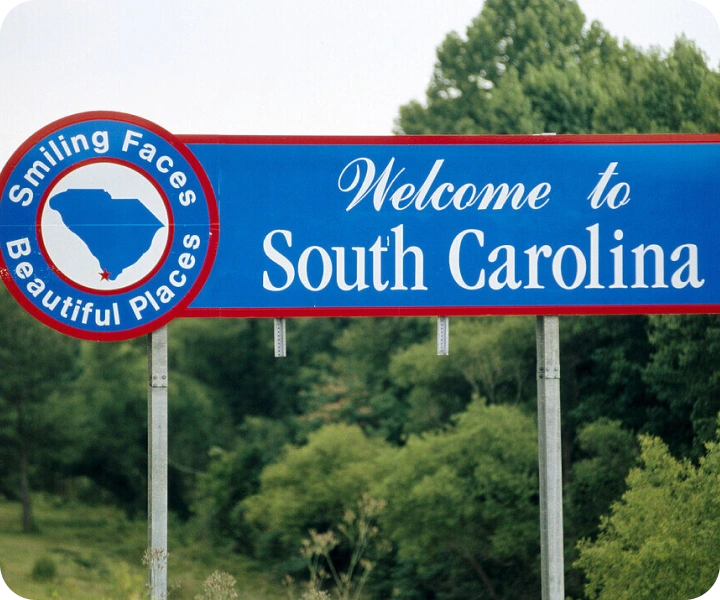
Our South Carolina truck parking locations
South Carolina truck parking guide: South Carolina major corridors — I-95, I-26, I-20 and US-17
South Carolina sits in a unique pocket of the Southeast where freight moves in a steady, 24-hour cycle that feels like the state's own heartbeat. You feel it the second you cross the border: the air grows heavy with sticky humidity and pines crowd closer to the road. The traffic is a blend found nowhere else—long-hauls from Florida, port trucks from Charleston, BMW and Michelin loads in the upstate, and farm rigs hauling Lowcountry produce all mix into one wide river of diesel and steel.
I-95 is the relentless spine of the East Coast, offering a long, hot stretch of highway that rarely gives drivers a break. While the pavement is smoother than in some states, morning humidity can feel like wet cement and sudden thunderstorms can turn the sky dark instantly. I-26 serves as the east-west lifeline tying Charleston's reefer and container freight to Columbia and the mountains. The closer you get to Charleston, the more the road feels like it is shrinking due to heavy rush hour volume.
I-20 ties the center of the state together with Columbia acting as the pivot point. The vibe around the city shifts between military freight from Fort Jackson and commercial loads cutting toward Georgia. While the pavement is decent, merges come quickly and visibility can vanish instantly if rain sweeps in from the west.
South Carolina major corridors
I-95
The relentless spine of the East Coast. Expect long, hot stretches where morning humidity feels like wet cement and thunderstorms can darken the sky in seconds.
I-26
The east-west lifeline for Charleston's reefer and container freight. The road feels like it is 'shrinking' during rush hour as you approach the coastal terminals.
I-20
Ties the state together through Columbia. Handles a mix of military freight and commercial loads heading toward Georgia.
US-17
The coastal scenic route. Beautiful but challenging for 53-foot trailers due to narrow stretches and sudden curves through coastal towns.
South Carolina local rules & compliance
South Carolina is friendlier than many states, but its rules serve a clear purpose. Idling restrictions are city-specific, with Charleston and Columbia enforcing limits near hospitals and schools. State law generally allows a 10-minute limit per hour with exemptions for truck stops and rest areas.
Parking is prohibited on highway shoulders and medians. As of 2025, Orangeburg and Spartanburg counties are aggressively towing rigs from residential curbs with fines exceeding $500. Weight enforcement is steady and fair, with a high focus on port zones near Charleston.
Compliance category | Legal Requirement (2025) | Driver "Real-World" Note |
|---|---|---|
Idling | 10-minute limit per hour (State Law) | Exemptions: You can idle freely at truck stops, rest areas, or anywhere >500ft from schools/homes. |
Parking | Prohibited on highway shoulders and medians | New for 2025: Orangeburg & Spartanburg are aggressively towing from residential curbs. |
Weight | 80,000 lbs GVW; 20k single / 34k tandem | Port Focus: STP use portable scales near Charleston for containers hitting I-26. |
Hazmat | Must follow National Hazmat Route Registry | Charleston Tunnels: Watch for "No Hazmat" signs on the I-526 Cooper River bridges. |
Securement | Standard FMCSA + strict timber/ag rules | Pines & Logs: Expect binder tension scrutiny if hauling timber on I-95. |
Move Over | Required for stationary emergency/utility vehicles | Zero Tolerance: Move left or drop 20 mph immediately if you see lights. |
South Carolina fuel & DEF planning
Fuel planning is as critical as finding safe truck parking in South Carolina because geography creates pockets where service stops disappear. Humidity and coastal traffic, upstate grades, and sudden jams around Columbia all cause fuel consumption to burn faster than expected.
DEF availability is strong near ports and along interstates but can be spotty late at night in the southeast edge of the state. Reefers leaving Charleston or Summerville should top off early to account for long idling sessions during port delays.


Learn more about TruxSpot’s advantages in our official mobile app
Secured and convenient parking for large vehicles.
Real-time booking.
Payment via card through the app.
Management of your own bookings directly from your phone.










South Carolina weigh stations & inspections
The inspection culture is professional and calm; officers know the routes and where trouble typically appears. Permanent weigh stations are active on I-95 near Ridgeland, I-26 near Dorchester, and I-20 near Lexington. Mobile inspections frequently pop up around Charleston port access roads, Columbia beltline interchanges, and the manufacturing loops in the upstate.
South Carolina managing final two-hours of HOS
Two hours in South Carolina is highly variable. In the Charleston area, it can mean just ten miles if the port is backed up, making timing to avoid the mid-morning wave critical. On I-95, predictable stretches can quickly become hydroplaning hazards during thunderstorms, while the upstate region features more hills and heavy traffic density during plant shift changes.
South Carolina last-mile to freight clusters
Charleston Port & Wando Welch Terminal: The state's primary freight node for containers and reefers; features tight approaches and strict security.
Columbia Beltline: Hub for distribution and military freight; good maneuvering room but subject to sudden traffic spikes at major interchanges.
Greenville–Spartanburg Upstate: Automotive corridor for BMW and Michelin; smooth highways but very sensitive to local plant shift changes.
Florence & I-95 Logistics Row: A more forgiving zone for regional distribution and warehousing.
Beaufort & Lowcountry: Industrial pockets for marine and specialty goods characterized by narrow roads and surprising elevation dips.