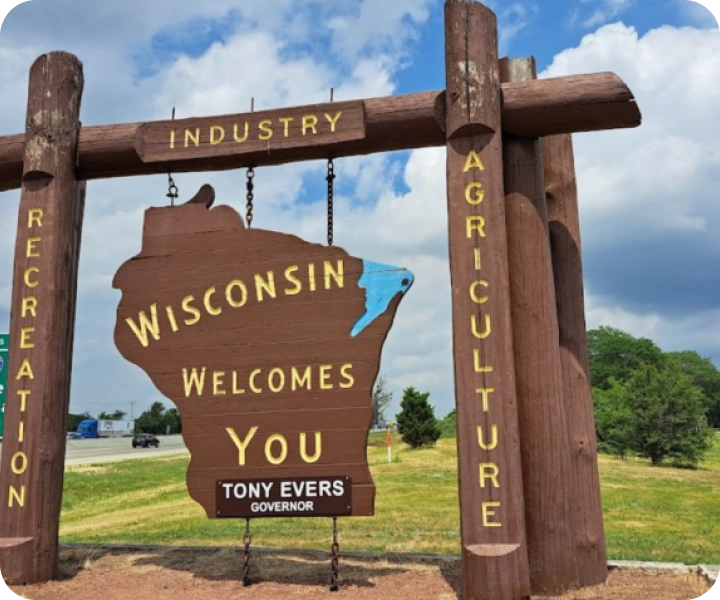
Wisconsin major corridors — I-90, I-94, I-41, US-151
Wisconsin can look calm when you’re not behind the wheel — open fields, steady hills, a lot of water, and long stretches that seem predictable. But once you start running freight through the state, the driving tells a different story. The terrain shifts enough to change your pace, the weather doesn’t follow a routine, and the traffic patterns don’t always match what the map makes you expect.
Each corridor has its own habits, and you feel them more when you’re moving a heavy load instead of just passing through. The terrain changes just enough to keep your foot adjusting on the pedal. The weather shifts like someone flipping channels. And the traffic — especially around Milwaukee and Madison — behaves in short, sharp bursts that don’t feel like the Midwest calm people talk about.
Wisconsin major corridors
I-90
A long diagonal slicing in from Minnesota toward the Illinois line. It looks predictable but never truly settles. Fog off the river valleys rolls in early, hangs late, and makes the morning commute around La Crosse feel tighter than it should. Once you pass Tomah, the road feels like it exhales, but the stretch toward Madison shifts into a stop-start pulse that demands full attention.
I-94
Starts out looking calm, but the driving rarely matches the scenery. The segment from the Twin Cities toward Eau Claire stays steady until traffic pockets form behind slow-moving clusters. Approaching Milwaukee, volume increases and the margin for error tightens as traffic density makes lanes feel smaller and reactive room disappears.
I-41
Looks simple on a map, but the drive rarely matches that. The traffic mix changes every few miles: steady commuter flow near Milwaukee, short and uneven surges from local factory runs near Oshkosh and Appleton, and inconsistent pacing further north where long-haul trucks fill most of the lane space.
US-151
Deceptively useful as a fast connector between Dubuque, Madison, and northern points. It looks rural, but the grades and wind can chew into your timing faster than you expect. Know your terrain and plan accordingly.
Wisconsin local rules & compliance
Wisconsin pays close attention to equipment, weight, and winter behavior. While idling isn’t heavily enforced statewide, Milwaukee and Madison have zones where local ordinances kick in—neighborhoods will complain even if industrial parks don't. Parking rules vary by municipality; small towns are often more lenient out of habit, but suburbs near bigger cities strictly prohibit overnight truck parking.
Seasonal restrictions are the real wildcard. Freeze-thaw cycles tear up pavement, leading counties to post temporary weight limits on rural routes during the 'Spring Thaw' (March–May). If you’re hauling heavy during this time, double-check your path to avoid strictly enforced overweight citations.
Topic | Legal Requirement (2025) | Driver "Real-World" Note |
|---|---|---|
Idling | No statewide ban. | APU Weight: 400 lbs exception for idle-reduction tech is standard. |
Seasonal Weight | Spring Thaw (March–May): Strict load cuts on "Class B" roads. | Overweight Permits: Strictly enforced during freeze-thaw cycles to prevent road damage. |
Move Over Law | Mandatory for all emergency AND hazard lights. | If you see lights, move over or drop to 20 mph under the limit. |
Parking | Prohibited on interstate shoulders/ramps. | Safe Haven: Small towns in the north are more lenient; stick to marked lots in the south. |
Chains | Not mandated by date. | Carrying a set is highly recommended for the "Northwoods" legs. |
Wisconsin fuel & DEF planning
Fuel planning is as critical as finding safe truck parking in Wisconsin because the state chips away at MPG in ways you don’t always see coming. It’s not about big mountains; it's the small, stacked hills, weather swings, and wind off the lakes that force more braking and acceleration than planned.
I-43 from Milwaukee to Green Bay is notorious for lake-effect wind that drags down MPG even on clear days. While DEF availability is good statewide, smaller stations in northern counties sometimes run low during deep cold snaps. If your tank is at a quarter, Wisconsin is about to test whether you planned ahead.
Corridor | Best Fuel Zones | Why These Work |
|---|---|---|
I-90/I-94 | Tomah and Mauston | Easy access, but be ready for reduced-visibility safety protocols due to morning fog. |
I-41 | Oshkosh and Appleton | Compensates for high-burn merging, lane shifts, and commuter pockets. |
I-43 | Milwaukee to Green Bay | Necessary to combat heavy lake-effect wind drag. |
US-151 | Madison to Dubuque | Reliable corridor, but wide storm sheets hit drag coefficients hard. |


Learn more about TruxSpot’s advantages in our official mobile app
Secured and convenient parking for large vehicles.
Real-time booking.
Payment via card through the app.
Management of your own bookings directly from your phone.










Wisconsin weigh stations & inspections
Wisconsin inspections are calm, methodical, and consistent. They focus on factors that keep winter crashes from getting worse: brakes, tires, lighting, securement, and matching paperwork. Permanent weigh stations are active on major interstates, and mobile units frequently target key manufacturing and agricultural hubs.
Corridor | Permanent Weigh Station | Mobile Unit Hotspots |
|---|---|---|
I-90 | Madison | Janesville–Beloit distribution belt |
I-94 | Hudson and Milwaukee | Port of Milwaukee access roads |
I-41 | Oshkosh | Fox Valley manufacturing zones |
I-43 | East Troy | Meat processing corridors near Green Bay |
Rural Routes | N/A | Logging/Agricultural regions north of Wausau |
Wisconsin managing final two-hours of HOS
Two hours in Wisconsin can feel generous or razor-thin. On the I-90/I-94 corridor between La Crosse and Milwaukee, weather or commuters can easily consume that entire window. In the Northwoods, weather doesn't warn you — it just 'switches on' with unexpected snow bands. On US-151, farm equipment, wind, and patchy sleet can erase your safety buffer fast.
Wisconsin last-mile to freight clusters
Milwaukee – Port, Food Processing, & Heavy Industry: Tight interchanges and quick merges; port access can get jammed at random.
Madison – Distribution & Tech Manufacturing: Traffic is deceptively thick with high volumes of short-haul movement and sudden slowdowns.
Fox Valley (Oshkosh–Appleton–Green Bay): Manufacturing and dairy hub; expect sudden lane changes from commuters and high local CDL activity.
Janesville–Beloit – Midwest Distribution Hub: Smooth roads but messy peak hours; excellent for staging with proper timing.
Central Wisconsin & Wausau – Logging, Agriculture, & Paper: Fine until winter sets in; requires traction, patience, and clean headlights.
Northern Counties – Forestry, Mining, & Seasonal Freight: Sparse fuel and services; staging matters more than speed here.