How to Reverse Park a Truck: A Step-by-Step Guide

Reverse parking is one of the most important skills every commercial truck driver must master. Whether you're backing into a truck stop, warehouse dock, distribution center, or secure truck parking lot, knowing how to reverse safely reduces the risk of accidents, property damage, and costly delays.
Even experienced CDL drivers occasionally need multiple pull-ups to complete a difficult backing maneuver. The goal isn't to park in one move—it's to park safely.
In this guide, we'll explain how to reverse park a truck step by step, common mistakes to avoid, and practical tips that make backing easier.
Before You Start Backing
Professional drivers tend to spend way more time getting ready than they do actually reversing.
Before you shift into reverse:
1. Take a moment to Walk about the truck (GOAL — Get Out And Look) , not just stay seated.
2. Identify the poles, curbs, trailer gear, pedestrians, and anything overhead that could sneak up on you.
3. Then check your mirrors, properly , and do a quick scan.
4. Turn off distractions, roll the window down if you need that extra view, and turn on your four way flashers when it makes sense.
Also don’t fall back on cameras alone. Your mirrors, plus direct visual checks, are still the main safety tools you should trust, every single time.
Step 1: Set Up the Truck
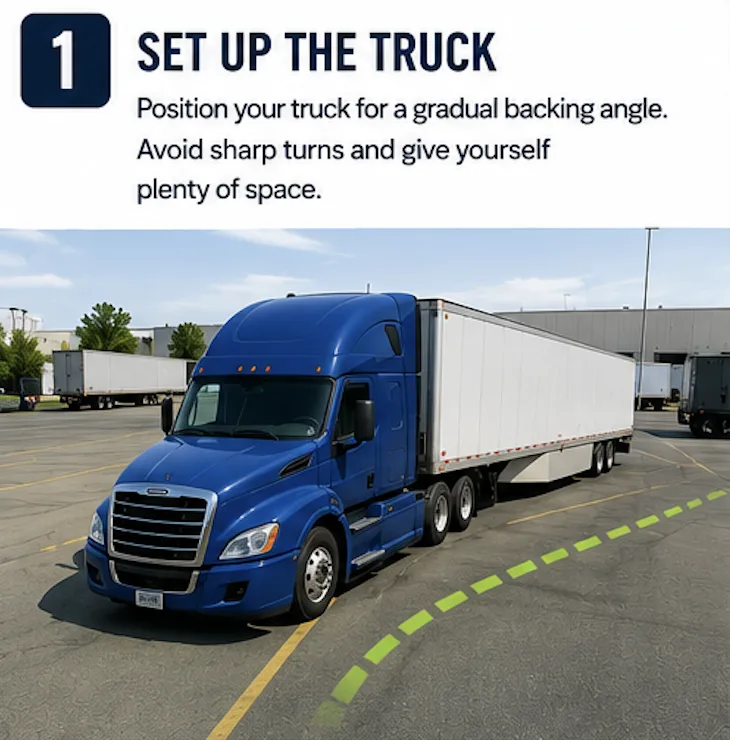
Good backing kinda starts with good positioning, you know—at least that’s the idea.
Whenever you can, try this:
- Give yourself more room ,like really plenty
- Set the trailer so you’ll have a slow backing angle, not a sudden one
- Don’t go into sharp jackknife angles before you even start
- Keep the tractor and trailer lined up as straight as practical
A weak setup tends to make an annoying parking maneuver, almost every time.
Step 2: Reverse Slowly
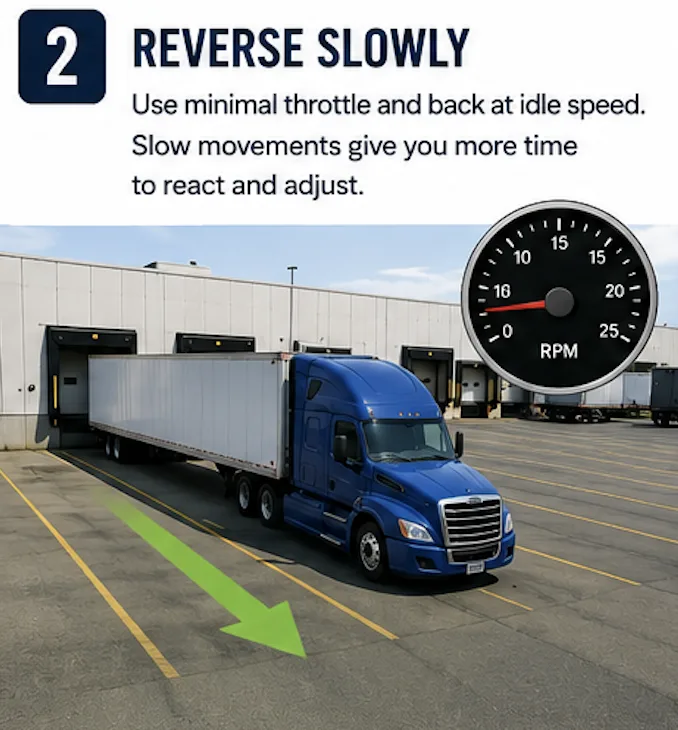
Speed is kind of the enemy of precision, yeah like it steals the detail. Professional drivers keep things at idle speed or use just a touch of throttle.
When you move slowly you basically buy time for:
- Spotting trailer movement
- Adjusting steering in time
- Stopping safely if it’s needed
- Keeping an eye on both mirrors , all the time
And remember, small steering inputs can cause large trailer movements.
Looking for
truck parking?
Find available truck parking near your route or destination with TruxSpot
Daily, hourly and monthly options available
Step 3: Watch Both Mirrors Constantly
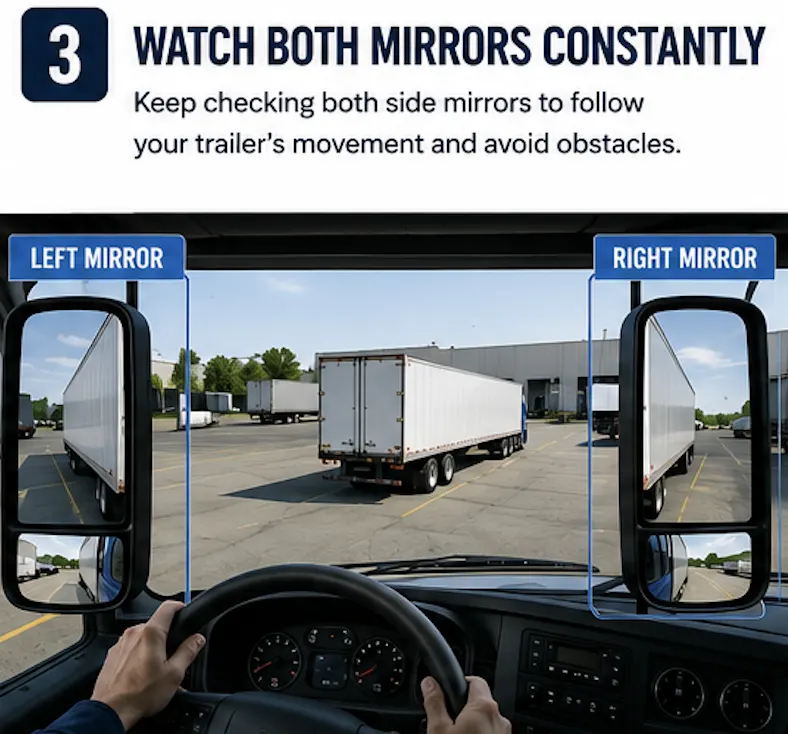
Your mirrors basically tell the whole story. Don’t, uh, lock onto just one mirror, like totally ignore the rest. Rather than that do this, kind of simple.
- Look at the driver’s side mirror
- Look at the passenger side mirror
- Go back to the driver’s side
- Keep doing it over and over again, continuously
The FMCSA suggests staying in a steady state of awareness around you , and checking the mirrors often when you are operating commercial vehicles.
Step 4: Make Small Steering Corrections
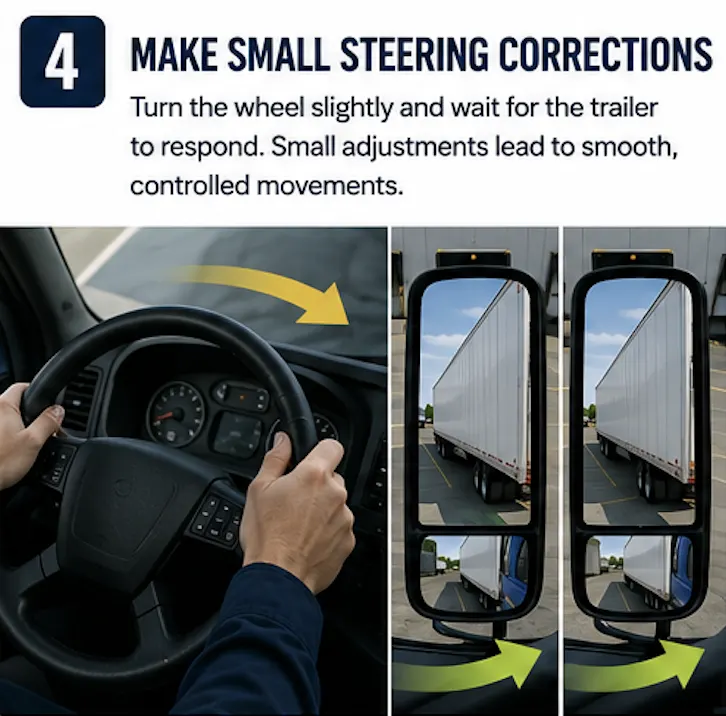
One of the biggest beginner mistakes is over steering, like i mean turning too much.
Instead of that,
- Turn the wheel a little bit
- Wait for the trailer to start reacting, and not immediately push again
- Correct in steps, bit by bit
- Straighten the steering wheel once the trailer begins moving toward the direction you want
Big steering inputs usually cause bigger compensations later, so it turns into this kind of loop.
Smooth movements are almost always the better option, honestly.
Step 5: Pull Up When Necessary
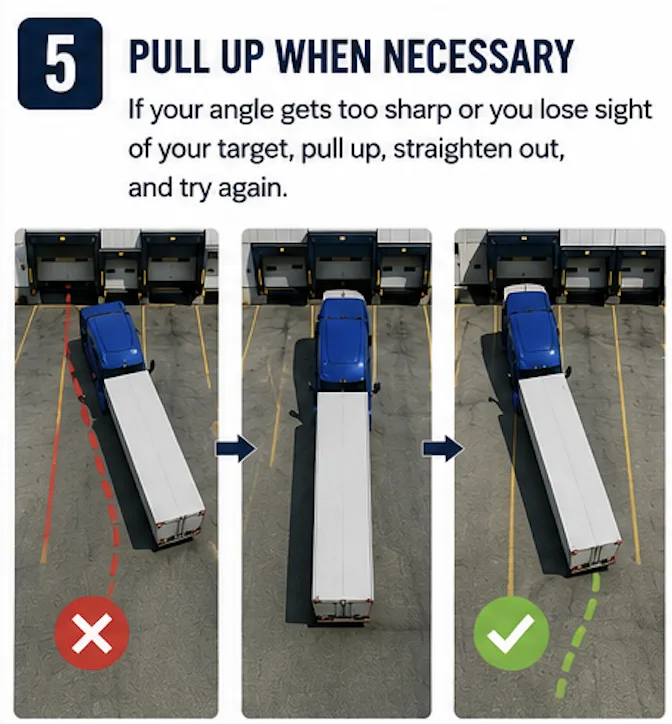
Even experienced drivers still do pull-ups.
A pull-up isn’t really a mistake, not at all. It’s more like a professional safety move that can help with a few things, such as:
- improving the trailer angle
- boosting visibility
- reducing the chance of jackknifing
- getting into position for a smoother, cleaner approach.
Lots of companies even encourage drivers to do extra pull-ups rather than forcing a bad backing angle, even if it feels a little indirect at first.
Step 6: Use GOAL (Get Out And Look)
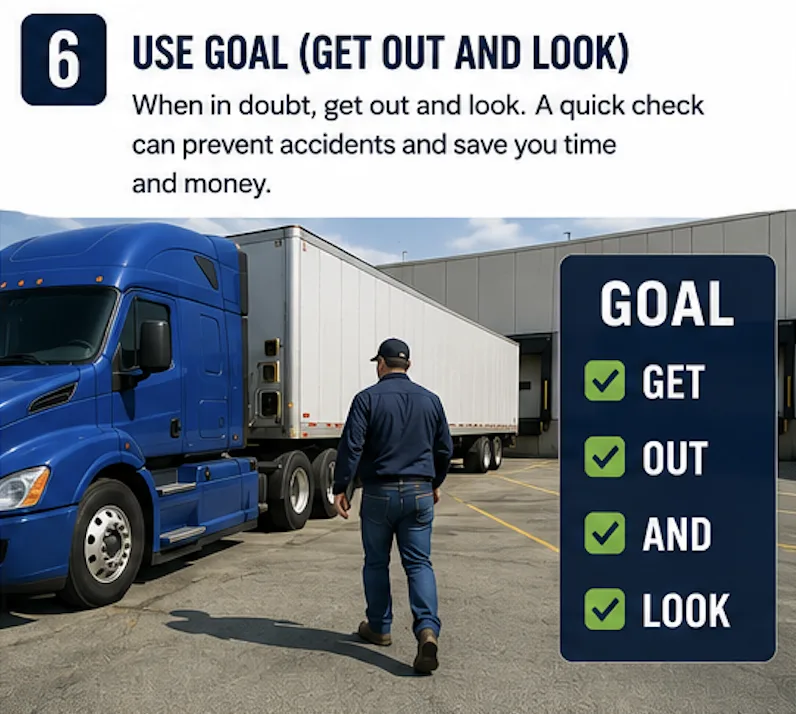
If your unsure— stop. Get out. Look.
The trucking industry has this simple rule, like it’s obvious:
GOAL — Get out and look.
Walk around the truck, whenever:
- You lose sight of some obstacle
- The trailer angle looks a bit questionable
- Space starts getting tight
- Pedestrians are nearby
- You’re reversing into an unfamiliar location
That one minute of checking, is way cheaper than repairing a trailer that got damaged or a loading dock.
Common Reverse Parking Methods
Straight-Line Backing
Basically the simplest maneuver, you just keep going like that, not much to it.
Best for:
- Truck parking lots
- Fuel islands
- Wide loading docks
Keep the tractor and trailer lined up , and only do small steering corrections.
Offset Backing
Used when sliding into a parking spot that’s right next to the current one, basically adjacent like, you know…
Requires:
- Controlled trailer angle
- Small steering tweaks
- Lots of quick pull ups if it turns out you need them, now and then.
Alley Dock Backing
Often considered the most difficult CDL maneuver.
Common in:
- Warehouses
- Freight terminals
- Distribution centers
This maneuver usually requires careful setup and continuous mirror monitoring.
Parallel Parking
Less common in everyday trucking but still included in some CDL training programs.
Requires:
- Excellent trailer control
- Proper spacing
- Multiple steering transitions
Common Mistakes New Drivers Make
Backing Too Fast
The faster you reverse, the harder it becomes to correct trailer movement.
Oversteering
Large steering inputs quickly create excessive trailer angles.
Ignoring the Passenger Mirror
Many collisions occur because drivers focus only on the driver's side.
Refusing to Pull Up
Trying to "save" a bad setup often makes the situation worse.
Professional drivers pull up whenever necessary.
Not Getting Out to Look
Never guess where your trailer is.
If you're uncertain—
GOAL.
Need
a place to park?
Search available truck parking and reserve your spot before you arrive
Search parking across the U.S.

Frequently Asked Questions
Is reverse parking required for a CDL?
Yes, in most cases reverse parking is required for a CDL. CDL applicants must show backing abilities during the commercial driver’s license skills test, like when you’re assessed under FMCSA rules . It’s not just a suggestion , it’s part of the evaluation.
How can I improve my truck backing skills?
If you’re trying to improve your truck backing skills, the best approach is pretty boring but effective, you know, practice regularly in an open parking lot. Use GOAL when you need it, then make little steering corrections instead of big yanks , and try not to rush the maneuver. Slow and steady usually wins.
Should I use pull-ups while backing?
Yes, pull-ups are generally viewed as good safety practice , and many seasoned drivers actually encourage them. It’s the whole idea of resetting the position before things get messy.
What`s the hardest backing maneuver?
A lot of CDL drivers say alley dock backing is the toughest, mainly because the trailer has to be controlled precisely in really tight spaces.
Is it okay to get out and check while backing?
Yes. Getting out to look whenever you’re uncertain is one of the safer habits a commercial driver can build . Sometimes that quick inspection saves the whole run from a problem.