Uphill & Downhill Parking Guide

Parking on a hill needs a bit more than just putting your vehicle in park and shutting off the engine. Whether you areparking uphillorparking downhill, you have to know how to set your wheels in a way that keeps the car from drifting into traffic, pedestrians, or even a nearby vehicle
Thisuphill downhill parking guidelays out the right moves for different cases, including when there is a curb and when there isn't.
Why uphill and downhill parking matters
Parking on an incline makes extra forces at work, and those can cause the vehicle to move when you least expect it. Gooddownhill then uphill parkinghabits matter because if the brakes give out, your vehicle should slide into the curb rather than into the flow of traffic
Many drivers training programs also test your knowledge ofup hill down hill parking, so yes it is an important skill
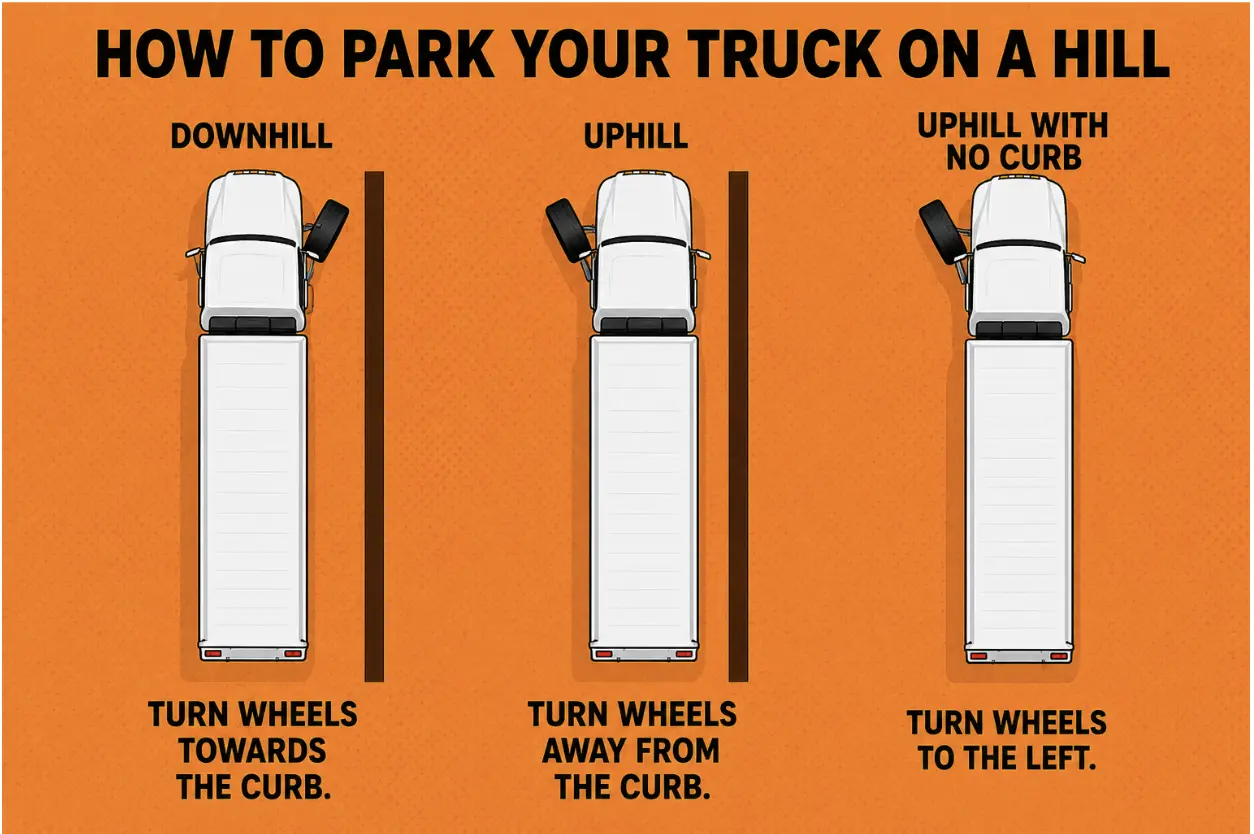
Uphill parking with a curb
When parking uphill next to a curb:
- Pull close to the curb.
- Turn your front wheels a away from the curb.
- Slowly let the vehicle roll back a little, until the rear tire makes a soft touch with the curb.
- Engage the parking brake
- Shift into Park (automatic) or first gear (manual) .
This routine makes sure that, if the vehicle creeps backward, the curb will stop it.
Remember:
Uphill + curb = wheels pointing away from the curb.
Uphill Parking Without a Curb
When parking uphill without any curb around:
- Turn the front wheels toward the edge of the road.
- Set the parking brake firmly, and keep it engaged.
- Put the transmission into Park, or first gear
With no curb acting as a stopper, angling the wheels toward the roadside helps keep the vehicle from rolling into traffic.
Have space
for trucks?
Put your available parking space to work.
List your property on TruxSpot and connect with truck drivers looking for parking
Free to list · Set your own prices
Parking Downhill With a Curb
Many drivers ask what to dowhen parking downhill.
Forparking downhillwith a curb:
- Pull close to the curb.
- Turn the front wheels, so they point toward the curb.
- Allow the vehicle to drift slowly until the front tire gently touches the curb.
- Apply the parking brake.
- Put the shifter into Park or into reverse for manual transmissions, (yeah even if you just moved a bit).
Remember:
Downhill + curb = the wheels facing the curb.
This is pretty much the key rule when you park downhill, because the curb works like a barrier if the vehicle starts rolling.
Parking downhill without a curb
If you are parking downhill on a street that has no curb then do this:
- Turn your wheels toward the outer edge of the road.
- Set the parking brake.
- Shift into Park, or reverse gear for a manual transmission.
That way, if anything slips, the vehicle tends to move away from traffic.
Downhill tires parking, wheel position
A lot of people misunderstand what 'downhill tires parking' means for wheel direction.
Here is a quick reference table:
| Situation | Wheel Direction |
|---|---|
| Uphill with curb | Away from curb |
| Uphill without curb | Toward road edge |
| Downhill with curb | Toward curb |
| Going downhill without curb | Toward the road edge |
Remembering these spots can really boost safety and help you get through the driving test.
Parking Up and Down a Hill: more safety things to remember
When you'reparking up and down a hill, make sure you always stick to these safety rules:
- Set the parking brake each time.
- Put automatic vehicles in Park.
- Keep manual vehicles in first gear when you're headed uphill, or reverse gear when you're headed downhill.
- Turn the steering wheels correctly depending on the incline and the curb.
- Look out for traffic before leaving the vehicle.
- Don't depend only on the transmission to keep the car from moving.
These small habits lower stress on your transmission and support safer vehicle control overall.
Typical blunders Drivers tend to make
People often slip up withuphill downhill parking, such as:
- Leaving the wheels straight instead of turning them.
- Turning the wheels the opposite way.
- Skipping the parking brake.
- Stopping too far from the curb.
Relying only on transmission to secure the vehicle.
Avoiding these errors can prevent accidents , and costly vehicle damage.
Ready to
list your truck parking?
Join TruxSpot and make your parking available to truck drivers searching for a place to park
Free to list · Set your own prices