What Zoning Is Required for Truck Parking and How to Comply?

Quick answer: Truck parking is generally acceptable within zones labeled I or M (e.g., I-1, M-2). Zones categorized for agriculture might permit it under specific circumstances, as can zones designated for transportation/logistics. In most circumstances, it is not permitted in residential zones. Even within most industrial zones, a standalone truck parking lot often requires a conditional use permit (CUP).
Whether it’s starting a truck parking facility, offering space to drivers to park their rigs, or even parking your rig on a lot you already own at home, the question that comes first is always the same. What zoning do I need to park my truck? Well, unfortunately there is no uniform national zoning code. Each jurisdiction has its own codes. While every municipality across the country develops their own zoning codes, they all tend to develop very similar ones. After learning them, you’ll find that screening a location takes much less time than responding to a zoning violation notice.
Why Zoning for Truck Parking Matters
Local governments put in zoning ordinances to keep land uses from clashing. Having something like a school or residential street near a distribution center creates lots of problems. Things like trucks that are heavy, loud noises, and exhaust at all hours of the day make zoning for things like distribution centers very tight. Trucks also require a lot of space for turning, unlike parking for a passenger vehicle. Therefore, zoning for a truck parking facility will take much longer and more oversight than a parking lot.
At the same time, the country needs much more of it. The Federal Highway Administration'sJason's Law truck parking surveysfound shortages in every state and region, and in the 2019 survey 98% of nearly 11,700 responding drivers reported problems finding safe parking. When legal spaces run out, drivers end up on ramps, shoulders, and residential streets — exactly what zoning is meant to prevent. We cover the scale of the problem in our article on thetruck parking shortage.
For property owners, this gap is an opportunity: a correctly zoned lot near a freight corridor can earn steady income. For drivers and fleets, understanding zoning explains why some places are legal to park and others lead to tickets or towing.
What Zoning Is Required for Truck Parking: District by District
Zone names differ from town to town — an "M-1" in one city may allow more than an "I-2" in the next — so always read the permitted-use table in your local ordinance. The table shows the typical pattern.
| Zoning district | Common codes | Truck parking as a standalone business | Truck parking as an accessory use |
|---|---|---|---|
| Heavy industrial | I-2, I-3, M-2, M-3, HI | Most likely allowed, by right or with a CUP | Usually allowed |
| Light industrial / industrial park | I-1, M-1, LI, IP | Sometimes allowed, often only with a CUP | Usually allowed |
| Transportation / logistics district or overlay | T, TL, freight overlays | Often allowed — built for terminals and yards | Allowed |
| Highway / general commercial | HC, CH, C-2, C-3 | Rarely by right; truck stops may be allowed with a permit | Limited (deliveries, short stays) |
| Agricultural / rural | A-1, AG, RU | Varies; a commercial lot usually needs rezoning or a special use permit | Owner's own farm trucks usually OK |
| Mixed-use / planned development | MU, MXD, PUD | Only if the approved plan includes it | Case by case |
| Residential | R-1 to R-4 | Prohibited in nearly all jurisdictions | Generally prohibited for semis |
Heavy Industrial Zones
Heavy industrial districts are built for large footprints, round-the-clock operations, and heavy traffic, which makes them the most reliable answer to what zoning is required for truck parking. Land here usually sits near highways and rail, and neighbors are other industrial users. Even so, many ordinances list "truck parking lot," "truck terminal," or "commercial vehicle storage" as a conditional use, so check before you buy.
Light Industrial Zones
Light industrial districts host warehousing, light manufacturing, and flex space. Parking the trucks that serve a business on the same site is typically fine. A standalone lot where parking is the business is more often restricted or sent to CUP review, because these districts can border residential neighborhoods.
Transportation and Logistics Districts
Some cities and counties have created freight or logistics zones, or overlays near ports, airports, and interchanges. Where they exist, they are often the easiest path: truck terminals,drop yards, and trailer storage are part of the intended use.
Commercial Zones
General commercial districts (retail, offices, restaurants) usually don't allow truck parking as a primary use. Highway commercial districts are worth checking — truck stops, travel centers, andhotels with truck parkingare often located there, typically with conditions on hours, idling, and screening.
Agricultural and Rural Zones
Rural land is cheap and spacious, so owners often ask whether they can turn a field into a truck lot. Farmers can usually park their own farm trucks, but renting spaces to outside drivers is a commercial use that typically requires a special use permit or rezoning.
Residential Zones
In residential zoning the answer is almost always no. Many ordinances ban commercial vehicles above a set weight (often around 10,000 lbs GVWR) or length from residential streets and driveways, except for brief loading or service calls. If that's your situation, read our guides onwhether you can park a semi in a residential neighborhoodand onparking commercial vehicles in residential areas.
Have space
for trucks?
Put your available parking space to work.
List your property on TruxSpot and connect with truck drivers looking for parking
Free to list · Set your own prices
What Zoning Is Required for Semi Truck Parking?
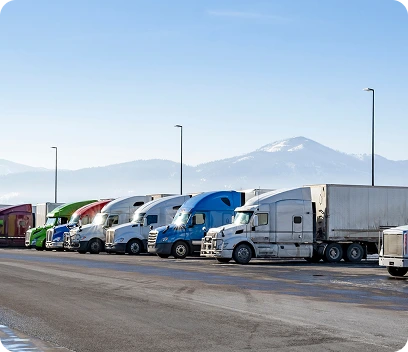
Semi trucks face stricter rules than box trucks or vans because of their size. A tractor-trailer commonly runs about 70–80 feet long (see oursemi truck dimensionsguide), needs wide turning space, and often idles or runs a reefer unit overnight. Here is what zoning is required for semi truck parking in the most common situations:
| Situation | Zoning that usually works |
|---|---|
| Standalone lot renting spaces to drivers | Heavy industrial or transportation/logistics; light industrial or highway commercial with a CUP |
| Fleet yard for your own trucks | Accessory use to a permitted industrial or logistics business on the same parcel |
| Trailer-only storage or drop lot | "Outdoor storage" or "vehicle storage yard" uses, typically industrial districts only |
| Overnight parking on public streets | Not a zoning question — set by local traffic ordinances; often banned or limited to posted areas |
| One semi at the owner's home | Prohibited in most residential districts; some rural or agricultural zones allow it with limits |
Some ordinances also cap truck size by weight, length, or axle count in specific districts. A lot approved for box trucks is not automatically approved forsemi truck parking.
Permitted, Conditional, or Accessory: How Your Use Is Classified
Knowing the district is only half the job. The ordinance also decides how truck parking is allowed there:
- Permitted by right. You meet the dimensional standards, submit a site plan, get a zoning or building permit, and proceed.
- Conditional use (CUP or special use permit). Approval comes only after review and usually a public hearing. Expect a site plan, sometimes a traffic study, neighbor notification, and conditions such as operating hours, a cap on trucks, landscaping, or lighting. The process often takes a few months.
- Accessory use. Parking is incidental to the main business on the parcel — for example, a carrier parking its tractors beside its warehouse. It rarely needs a separate permit, but a parking business can't be labeled "accessory" to skip review.
- Variance. If you can't meet one standard (say, a setback on an oddly shaped lot), a variance can relax it. It does not change which uses are allowed.
- Legal nonconforming use. A lot that was legal when it opened can often keep operating after a rezoning, but expanding it or leaving it idle for too long can end that protection.
Ordinances use different names for the same use — "truck terminal," "truck stop," "commercial vehicle storage," "heavy vehicle parking," "outdoor storage yard." Search for all of them when you read the code.
Site Requirements That Come With Zoning Approval
Approval almost always comes with design standards. The exact numbers vary, but planners typically check:
- Surface and drainage. Paved or stabilized gravel surfaces and a stormwater plan; dust and mud tracked onto public roads are common objections.
- Stall size and circulation. Stalls long and wide enough for tractor-trailers, plus aisles and turning radii so trucks never back onto the street. Ourtruck parking lot layout and dimensionsguide covers typical figures.
- Access points. Driveways placed away from busy intersections, with sight distance for slow-moving trucks.
- Setbacks, buffers, and screening. Distance from property lines and residential zones, plus fencing, berms, or landscaping.
- Lighting. Enough for safety and security, shielded so it doesn't spill onto neighbors.
- Noise and idling. Limits on idling time or operating hours; the federalNoise Control Actunderpins many local noise rules. Some communities favor electrified spaces so trucks don't need to idle.
- Security. Fencing, gated access, and cameras are often expected — and drivers look for them too (seesafe truck parkingand ourcargo theft prevention tips).
How Local Governments Use Zoning to Create Truck Parking
Zoning is not only a list of restrictions. A 2018 FHWA working-group report,Parking and Staging Requirements in Local Zoning and Planning, collected examples of communities that used zoning and public land to add truck parking:
- Weed, California turned two pieces of city-owned, industrially zoned land along I-5 into municipal parking for about 30 trucks, with stays of up to 72 hours.
- Elmira, New York converted an industrial-zoned lot off I-86 into about 25 truck spaces; resident complaints about trucks in neighborhoods dropped after it opened.
- Carson, California bans larger commercial vehicles (over 6,000 lbs, 25 feet long, or 96 inches wide) from city streets except at locations the city designates and posts, and pairs this with designated truck routes.
- Moreno Valley, California designates specific roadways for commercial truck parking — some overnight only, some at all times — with stays of up to 72 hours.
The same report suggests zoning codes could require truck parking and staging for uses that generate heavy truck traffic, the way they already require car parking for stores and offices. FHWA'struck parking pagealso lists the Truck Parking Development Handbook and National Coalition on Truck Parking materials for planners. Drivers looking for lots like these can browse truck parking inCaliforniaorNew York.
Federal Rules That Shape Local Truck Parking Decisions
Zoning is local, but two federal rules explain why truck parking can't simply be zoned out of existence:
- Hours of Service. Under49 CFR Part 395, drivers must stop and rest after set driving limits, wherever they happen to be. Every community along a freight route therefore generates parking demand. OurHours of Service guideexplains the limits.
- Jason's Law. Named after driver Jason Rivenburg, who was killed in 2009 while parked at an abandoned gas station, the law made truck parking a national priority, opened federal highway funding to truck parking projects, and led to FHWA's nationaltruck parking surveys.
These rules don't override your local zoning code, but they explain why many states and cities now look for ways to add capacity rather than restrict it.
How to Check Zoning for Truck Parking on a Specific Property
Before you buy, lease, or invest in a lot, take these steps:
- Find the parcel's zoning. Most city and county planning departments publish an online GIS zoning map searchable by address or parcel number.
- Read the permitted-use table. Open the zoning ordinance on the municipality's website and look up your district. Search every variant: "truck parking," "truck terminal," "commercial vehicle storage," "outdoor storage."
- Check for overlays. Airport, floodplain, corridor, or historic overlays can add restrictions on top of the base district.
- Talk to the planning department. A short pre-application meeting tells you whether the use is permitted by right or needs a CUP, plus the fees, timeline, and site standards.
- Look beyond zoning. Ask about stormwater permits, a driveway permit from the state DOT if access is from a state highway, fire code, and business licensing.
- Get it in writing. A zoning verification letter protects you before you sign a purchase or lease.
Shopping for land? Browsetruck parking lots for saleandtruck parking for lease, then read our step-by-step guide onhow to start a truck parking lot businessand thepros and cons of a truck parking business.
Already Have a Properly Zoned Lot? Put It to Work
Once your lot is approved, the next job is filling it. On TruxSpot, owners of industrial yards, truck lots, and other properly zoned land canlist their truck parkingfor free, set their own prices, and get bookings from drivers looking fordaily,monthly, orlong-term truck parking.
For drivers, the easiest way to stay on the right side of zoning rules is to book a spot that's already legal: findovernight truck parkingorcommercial truck parking for rentin your state, such asNew JerseyorTexas. Fleets can reserve multiple spaces throughfleet parking.
Ready to
list your truck parking?
Join TruxSpot and make your parking available to truck drivers searching for a place to park
Free to list · Set your own prices
Frequently Asked Questions
This article is for general information and isn't legal advice. Zoning rules vary by jurisdiction — confirm requirements with your local planning department or a land-use attorney.
Jesse Voysey is a seasoned trucking industry professional currently working for TruxSpot. Jesse writes engaging and practical content designed to help truck drivers, fleet managers, and other industry stakeholders. His articles focus on real-world issues such as parking, safety, route planning, and equipment maintenance. Readers appreciate Jesse’s clear instructions, safety-focused tips, and insights based on his day-to-day work in the trucking industry.