How Many Trucks Can Be Parked on an Acre?

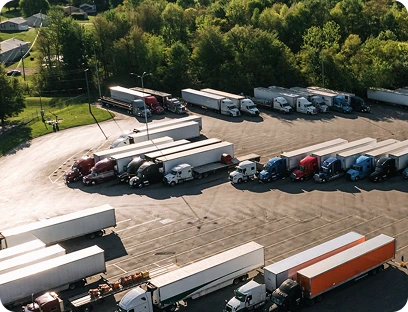
One acre (43,560 sq ft) typically holds 20–30 semi trucks with trailers. A bare-bones, well-shaped lot with pull-through rows can reach about 35. Trailer-only storage fits 35–40 per acre, while a lot with buildings, landscaping, and wide turning areas may hold only 15–20.
How Many Trucks Can Fit on an Acre?
To estimate how many parking spaces per acre your site can hold, use this simple formula:
Truck spaces per acre = (43,560 × usable share) ÷ square feet per truck (stall + its share of aisles)
On most sites, 75–85% of the land ends up usable for stalls and aisles; the rest goes to entrances, setbacks, drainage, and fencing. Plugging in typical numbers gives these planning ranges:
| Lot type | Approx. sq ft per truck | Semis per acre |
|---|---|---|
| Bare-bones lot, pull-through rows, rectangular shape | ~1,200–1,300 | 25–30 (up to ~35) |
| Standard lot with angled or back-in stalls | ~1,400–1,600 | 20–25 |
| Spacious lot with amenities, landscaping, wide turns | ~1,700–2,200 | 15–20 |
Many planners aim for the middle of the range. Squeezing in the last few stalls often makes the lot harder and less safe to use, which hurts occupancy more than the extra spaces help.
Larger parcels usually fit slightly more trucks per acre, because entrances and main circulation lanes are shared across more stalls:
| Parcel size | Approx. semi truck spaces |
|---|---|
| 1 acre | 20–25 |
| 2 acres | 45–55 |
| 5 acres | 120–140 |
| 10 acres | 250–280 |
These are estimates for a parking-only lot. A civil engineer's site plan will give you the exact count for your parcel.
Type and Size of Trucks
The vehicles you plan to serve matter as much as the layout. A lot designed for box trucks can hold twice as many vehicles as one built for full tractor-trailers.
Semi Trucks (Tractor-Trailers)
Semis are the largest vehicles in most truck lots. A tractor with a 53-foot trailer runs about 70–75 feet long and 8.5 feet wide (see oursemi truck dimensionsguide). Typical truck parking dimensions for a semi stall are:
- Width: about 12 feet (11–14 feet depending on design and local code)
- Length: about 70–80 feet
- Stall area: roughly 850–1,000 sq ft, before aisles
Add drive aisles and turning room, and each semi effectively uses 1,200–1,800 sq ft of land. A lot built forsemi truck parkingmust plan for the full turning radius of a tractor-trailer at every corner and entrance. More detail on stall layouts is in our guide totruck parking lot layout and dimensions.
Box Trucks
Box trucks are much shorter — commonly 16 to 26 feet for the cargo box — so a stall around 12 × 35–40 feet is usually enough. They still need room to maneuver, but far less than a semi, so a lot dedicated tobox truck parkingcan hold roughly 45–55 vehicles per acre.
Flatbed Trucks
Flatbed trailers are similar in length to dry vans (48–53 feet), so they need full-size semi stalls. Many lots add a little extra side clearance so drivers can walk around the load to check straps, chains, and tarps. Oversized or heavy-haul loads need even more room, which is why some lots offer separateflatbed truck parkingareas.
Bobtails and Trailers Only
Not every customer parks a full rig. A bobtail tractor without a trailer needs only about 25–30 feet of stall length, and a trailer stored on its own (with no tractor) needs about 55–60 feet. Trailer storage and drop yards can therefore pack in more units per acre — learn more aboutwhat a drop yard is.
| Vehicle | Typical stall | Approx. spaces per acre |
|---|---|---|
| Semi truck + 53' trailer | 12' × 70–80' | 20–30 |
| Flatbed rig | 12–14' × 70–80' | 18–28 |
| Trailer only | 12' × 55–60' | 35–40 |
| Box truck (26') | 12' × 35–40' | 45–55 |
| Bobtail tractor | 12' × 25–30' | 50–65 |
Have space
for trucks?
Put your available parking space to work.
List your property on TruxSpot and connect with truck drivers looking for parking
Free to list · Set your own prices
Factors Influencing the Number of Trucks Parked
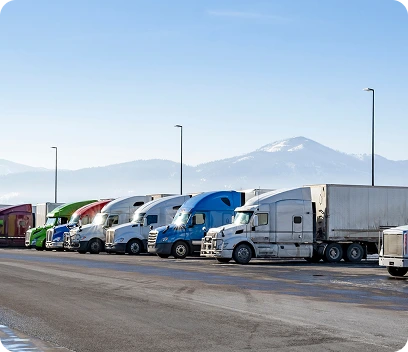
Two parcels of the same size can hold very different numbers of trucks. Beyond layout and vehicle type, these factors decide your final count:
- Lot shape. Long rectangles fit full rows of stalls efficiently; triangles, narrow strips, and curved boundaries waste space at the edges.
- Mixed vehicle sizes. Serving semis, box trucks, and trailers on one lot adds flexibility, but zones for each vehicle type need their own aisles and can lower overall density.
- Entrances and turning room. Semis need wide driveways and large turning radii at every corner and gate.
- Space for amenities. A guard booth, office, restrooms, or a driver lounge all take land away from stalls — though they can also justify higher prices.
- Stormwater and surface. Detention ponds or swales can take 5–15% of a site, and steep or soft ground may be unusable without grading.
- Local regulations. Setbacks, landscaping buffers, fencing, lighting, and fire-lane requirements vary by city and county. Many jurisdictions also require truck lots to sit in industrial zones, often with a conditional use permit — seewhat zoning is required for truck parking.
How Many Acres Do You Need for a Truck Stop?
A full-service truck stop holds far fewer trucks per acre than a parking-only lot, because fuel islands, a store, a scale, car parking, and landscaping share the site. Real projects show the scale:
- A planned travel stop inSusanville, Californiacovers about 14 acres with 70 standard truck spaces, 53 car spaces, a 4-position truck fueling station, and a truck scale. Landscaping alone takes about 20% of the site.
- A permitted truck stop site along I-24 in Jasper, Tennessee, totals about 14.6 acres with 72 truck spaces, a convenience store, a truck repair building, and fuel lanes.
That's roughly 5 truck spaces per acre for a full-service truck stop, compared with 20–30 for a parking-only lot.
| Facility type | Typical site size |
|---|---|
| Truck parking lot only (no fuel) | 1–5 acres for 20–140 trucks |
| Small fuel stop with limited parking | 3–8 acres |
| Full-service truck stop | 10–20 acres |
| Large travel center with restaurant, shop, hotel | 20–40+ acres |
What an Acre of Truck Parking Can Earn
Once you know your capacity, you can estimate income. As an illustration, 25 semi spaces on one acre rented at $250 per month bring in $6,250 a month, or $75,000 a year, before costs. Real prices depend on location, demand, and amenities — check currenttruck parking ratesfor a benchmark. Daily and overnight bookings can earn more per space thanmonthly truck parking, but occupancy is less predictable.
To Summarize
One acre usually holds 20–30 semi trucks, but the real number for your land depends on the layout you choose, the trucks you plan to serve, the shape of the parcel, and local rules. Pull-through and angled layouts balance density with safety; trailer-only and box truck lots fit more vehicles; full truck stops fit far fewer per acre. Aim for a layout drivers find easy to use, and the lot will stay full.
If you're shopping for a site, browsetruck lots for saleandtruck parking for lease, and read our guide onhow to start a truck parking lot business.
Already own a yard or a few spare acres? You don't need to build a truck stop to earn from it.List your truck parking on TruxSpotfor free, set your own prices, and get bookings from drivers andfleetslooking fortrailer parking,long-term truck parking, and overnight stays.
Ready to
list your truck parking?
Join TruxSpot and make your parking available to truck drivers searching for a place to park
Free to list · Set your own prices
Frequently Asked Questions
How many truck parking spots per acre?
Most truck lots fit 20–30 semi trucks with trailers per acre. A bare-bones rectangular lot with pull-through rows can reach about 35, while a lot with amenities and landscaping may hold 15–20.
How many trailers can be parked on an acre?
Without tractors attached, about 35–40 trailers per acre, because each needs only a 55–60-foot stall.
How many box trucks fit on an acre?
Roughly 45–55 box trucks per acre, using stalls of about 12 × 35–40 feet.
What are standard truck parking dimensions?
A semi truck stall is usually about 12 feet wide and 70–80 feet long, plus wide drive aisles and turning room. Including circulation, each semi uses about 1,200–1,800 square feet of land.